The organs of Paris
ORGANS OF PARIS © 2026 Vincent Hildebrandt HOME ALL ORGANS

Eglise Protestante

Unie

Oratoire du Louvre

145, rue Saint-Honoré, 75001 Paris

Orgue de tribune OdC >

Oratoire du Louvre. Originally conceived as a church by the Congregation of the Oratory of Jesus, this building—set between Rue de Rivoli, Rue de l’Oratoire, and Rue Saint-Honoré—went through many twists and turns during its construction. The foundation stone was laid on 22 September 1621, but the church would only be fully completed much later. Still unfinished but already designated as the Royal Oratory, it was here that the funeral services for Richelieu, Louis XIII, and Queens Anne of Austria and Marie-Thérèse were held. Richly decorated, the Royal Oratory featured an imposing canopied high altar, notably adorned with sculptures by François Pollet. The building and its interior decoration were completed in 1748, and two years later, on 12 July 1750, this church—begun 130 years earlier—was finally consecrated. Probably because of the spirit of independence within the Oratorian congregation, the Revolution was at first rather well received. However, the congregation itself was ultimately swept away by revolutionary violence in August 1792. The Oratory was suppressed and, like most churches, the building was ransacked and looted in 1793: tombs in the side chapels were destroyed, coats of arms, portal sculptures, fleurs-de-lis on the vaults and stained-glass windows, and almost all the interior paintings were either destroyed or sold. The building was then used as a lecture hall, study space, and storage for theatre sets. At the beginning of the 19th century, the Concordat and Napoleon I gave the Oratory a new lease of life. Although the church was made available to the Reformed (Protestant) congregation by Napoleon in 1811, this was only temporary, and it was not until 1844 that its assignment to the Reformed Consistory became permanent. In the 20th century, the Oratoire du Louvre became a major centre of French Protestantism. Since then, under the influence of many pastors, artists, its choir, and its organists, it has developed a rich musical life in which the music of J. S. Bach is never far away.

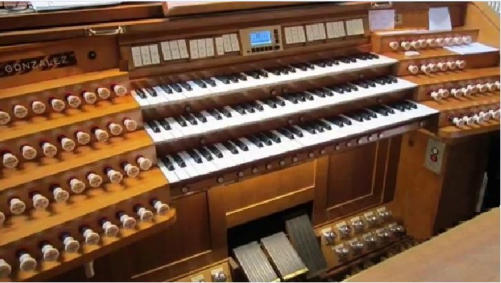
D1 There is hardly any information left on the organs of the Oratory before the Revolution. It is clear that the church of the Oratory, then a royal parish, must have possessed an instrument of great quality.  Assigned by Napoleon to the Reformed cult in 1811, the Oratory received the old organ of the church of St Louis du Louvre. It had been donated by Louis Féline, a member of the Reformed Consistory. Quickly judged insufficient to accompany the singing of the Psalms, it was ceded in 1835 to the Reformed parish of Nantes.  1828 The Consistory ordered an instrument with 3 manuals and 26 stops (including 10 reeds) from the organ builder Callinet-Somer. It sat in an empire-style sideboard designed by Hippolyte Godde. In 1845, at the instigation of the titular organist E. Meumann, a project to build a larger organ (with 32 feet and 56 stops) was born. Meumann then argued that the latter would then be better able to accompany Protestant worship. After much procrastination, it was finally only a restoration with a few repairs that was carried out in 1852 by the Maison Cavaillé-Coll who then took care of the maintenance of the organ.   1898 As part of a major renovation of the church, a new reconstruction of the organ was envisaged.  The work was entrusted to Joseph Merklin, who increased the instrument to 32 stops, installed an upside-down console and equipped the instrument with a pneumatic transmission. The alterations were paid for by a bequest from a parishioner.   This instrument performed well until the 1950s, when the instrument showed many signs of fatigue.  1962 After various consultations, the parish favoured the construction of a new organ on a new, more spacious gallery (to accommodate the Oratory's large choir). The construction of the new instrument was then entrusted to the Gonzalez establishments, which created a neoclassical organ without an electropneumatic action case, with 3 manuals and pedal and 67 stops. 32 stops of the previous organ were integrated and completely re-voiced. The stoplist was entrusted to Norbert Dufourcq. In order to keep as much space as possible on the tribune, the back positive was placed in 2 parts in side niches on either side of the tribune.  The instrument was inaugurated in January 1962 by Alexandre Cellier, Marcel Dupré and M.-L. Girod-Parrot.   1987 Overahul by Jean-Marc Cicchéro.   2012 Installation of an electric traction, an electronic combiner, a sequencer and a transposer by Bernrad Dargassies.  2014-2015 Overhaul by Bernard Dargassies.  Site of the organ
1962 - Danion-Gonzalez (3) 1987 - Jean-Marc Cicchéro (6) 2012/2014 - Dargassies (5)

III/67 (58) - transmission électrique -

stoplist

Organiste titulaire David Cassan, Sarah Kim Assistants: Alexandre Korovitch, Aurélien Peter Famous organists in the past : Henriette Puig-Roget (1934-1952), Marie-Louise Girod (1941-2008) Parish website Videos Jean-Dominique Pasquet (ancien titulaire) Photos Buffet : Jeroen de Haan Console : Thierry Correard
Organs of Paris

Eglise Protestante

Unie

Oratoire du Louvre

145, rue Saint-Honoré, 75001 Paris

Orgue de tribune OdC >

ORGANS OF PARIS © 2026 Vincent Hildebrandt
D1 There is hardly any information left on the organs of the Oratory before the Revolution. It is clear that the church of the Oratory, then a royal parish, must have possessed an instrument of great quality.  Assigned by Napoleon to the Reformed cult in 1811, the Oratory received the old organ of the church of St Louis du Louvre. It had been donated by Louis Féline, a member of the Reformed Consistory. Quickly judged insufficient to accompany the singing of the Psalms, it was ceded in 1835 to the Reformed parish of Nantes.  1828 The Consistory ordered an instrument with 3 manuals and 26 stops (including 10 reeds) from the organ builder Callinet-Somer. It sat in an empire-style sideboard designed by Hippolyte Godde. In 1845, at the instigation of the titular organist E. Meumann, a project to build a larger organ (with 32 feet and 56 stops) was born. Meumann then argued that the latter would then be better able to accompany Protestant worship. After much procrastination, it was finally only a restoration with a few repairs that was carried out in 1852 by the Maison Cavaillé-Coll who then took care of the maintenance of the organ.   1898 As part of a major renovation of the church, a new reconstruction of the organ was envisaged.  The work was entrusted to Joseph Merklin, who increased the instrument to 32 stops, installed an upside-down console and equipped the instrument with a pneumatic transmission. The alterations were paid for by a bequest from a parishioner.   This instrument performed well until the 1950s, when the instrument showed many signs of fatigue.  1962 After various consultations, the parish favoured the construction of a new organ on a new, more spacious gallery (to accommodate the Oratory's large choir). The construction of the new instrument was then entrusted to the Gonzalez establishments, which created a neoclassical organ without an electropneumatic action case, with 3 manuals and pedal and 67 stops. 32 stops of the previous organ were integrated and completely re-voiced. The stoplist was entrusted to Norbert Dufourcq. In order to keep as much space as possible on the tribune, the back positive was placed in 2 parts in side niches on either side of the tribune.  The instrument was inaugurated in January 1962 by Alexandre Cellier, Marcel Dupré and M.-L. Girod-Parrot.   1987 Overahul by Jean-Marc Cicchéro.   2012 Installation of an electric traction, an electronic combiner, a sequencer and a transposer by Bernrad Dargassies.  2014-2015 Overhaul by Bernard Dargassies.  Site of the organ
Organiste titulaire David Cassan, Sarah Kim Assistants: Alexandre Korovitch, Aurélien Peter Famous organists in the past : Henriette Puig-Roget (1934- 1952), Marie-Louise Girod (1941-2008) Parish website Videos Jean-Dominique Pasquet (ancien titulaire) Photos Buffet : Jeroen de Haan Console : Thierry Correard
1962 - Danion-Gonzalez (3) 1987 - Jean-Marc Cicchéro (6) 2012/2014 - Dargassies (5)

III/67 (58) - transmission électrique -

stoplist